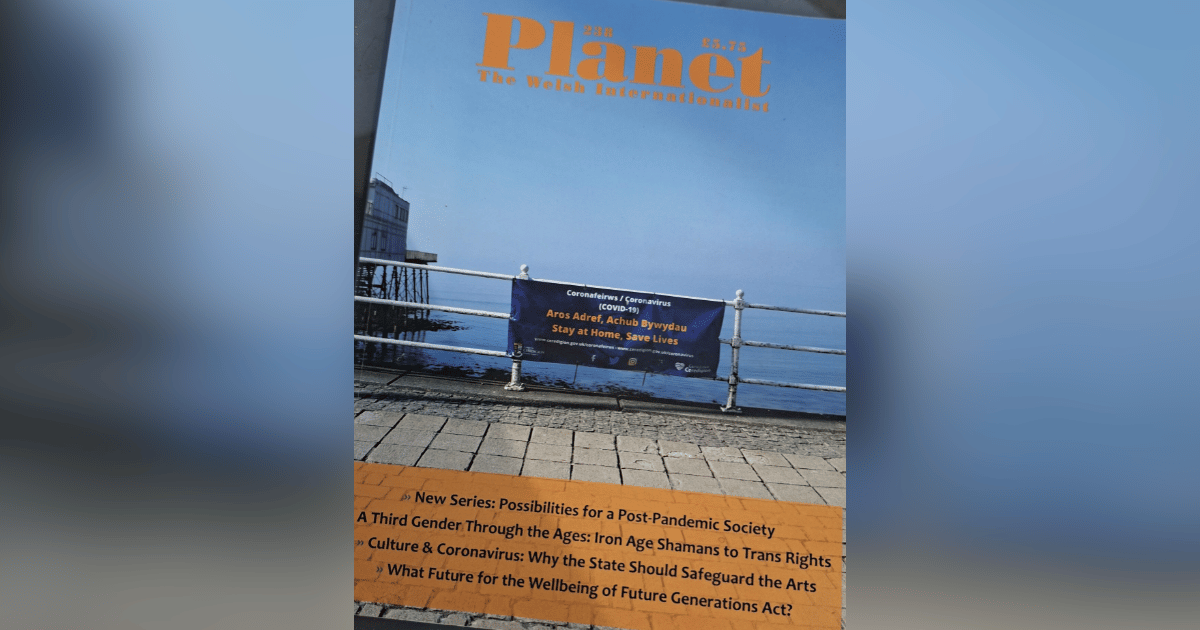
This article was first published in 2020 in Planet – The Welsh Internationalist (issue #238). All rights reserved
We write this at the end of week one of the national lockdown precipitated by the Covid-19 pandemic. It is still early days with, we are told at the time of writing, worse to come in terms of infections and fatalities.
Without wishing to play the crisis down or to ignore the Herculean effort of health workers treating the sick, there has simultaneously been a sense of disorientation and of reconnection, even tranquility. On the one hand, routines have been disrupted, fears have emerged, norms questioned, orthodoxies challenged and freedoms curtailed. Work has abruptly ended for many people, which has brought great anxiety. On the other hand, the commute has ended for many too. Our rare ventures beyond our front door are for the necessities of sustenance, exercise (for us and the dog), fresh air and social interaction, albeit at a distance. In addition to being more neighbourly with those we are already locally acquainted with, how many of us have found ourselves more readily greeting, and being greeted by, a stranger on our walks?
Social media has been awash with people re-connecting with lost hobbies, home-baking and their creative selves. There can be few parents who do not feel more engaged with their children’s learning as they return, of sorts, to the classroom by playing teacher in their new home-schooling environments.
While it may be too early to predict what will emerge from the pandemic, we would point to such (re)connections as an encouraging sign that people and communities are being reminded of the importance and value of social bonds, networks and reciprocity; of social capital.
Social capital gained popular attention following Robert Putnam’s book Bowling Alone (2000) in which Putnam’s titular signature observation was that despite the numbers of people populating the USA’s bowling alleys increasing, the number of bowling leagues had declined rapidly.
Putnam was keen to highlight the founding contribution to the concept of social capital of his compatriot L.J. Hanifan, a progressive, reforming educationalist from West Virginia. In 1916 Hanifan defined social capital as:
The tangible substances [that] count for most in the daily lives of people: namely good will, fellowship, sympathy, and social intercourse among the individuals and families who make up a social unit … [When the individual] comes into contact with his neighbor, and they with other neighbors, there will be an accumulation of social capital, which may immediately satisfy his social needs and which may bear a social potentiality sufficient to the substantial improvement of living conditions in the whole community.
Despite gaining little traction at the time, Putnam describes Hanifan’s theories as ‘sunken treasure … revealed by shifting sands and tides’; his writings anticipated so many significant ideas of leading twentieth-century sociologists and theorists such as Jane Jacobs, Pierre Bourdieu and James Coleman. Putnam’s key contribution at the end of the century was to typologise social capital within two categories. Firstly, ‘bonding’: this is a form of social capital that is inward-looking and re-enforces exclusive identities and homogenous groups; being with ‘people like me’. Secondly, bridging: this is a form of social capital that is more outward-looking across diverse social boundaries; with ‘people less like me’. It is important to point out that social capital of all forms can be put to use for positive or negative ends. Consider, for instance, the ‘honour among thieves’ or the ties between gang members as examples of how strong bonding social capital can be put to nefarious ends.
We run a social enterprise called Grow Social Capital, and we would argue that in Wales, and beyond, we need a revolution in how we value social capital. Might the Covid-19 outbreak be the stimulus for that revolution? Or might it lead to a more suspicious society, given the remarkably petty reports of people being ‘shopped’ to the police for taking a second form of daily exercise?
More immediately however, the early days of the crisis in the UK brought a previous lethal crisis to our minds; and one from which we might learn valuable lessons. In the Summer of 1995 the city of Chicago experienced an unprecedented heatwave. Like many conurbations, Chicago is a heat island whose concrete paving and glass skyscrapers act to accentuate heat: so though the mercury in thermometers on 12 July read 41oC, the heat index reached 52oC. To put this in context, Wales’s highest temperature on record is 35.2oC recorded at Hawarden, Flintshire in August 1990.
People cranked up their air conditioning units, overwhelming the electricity grid and causing outages in almost a quarter of a million homes, some lasting days. Railways buckled, children trapped on gridlocked school buses were hosed down to keep cool. Hospitals closed to new admissions. Grimly reminiscent of our hospitals during the pandemic, Chicago’s morgue ran out of bays. A meatpacking company lent its refrigerated lorries to the Medical Examiner for Chicago’s Cook County to store the surplus corpses. In the following week 739 excess deaths in Chicago were recorded.
Chicagoan sociologist Eric Klinenberg researched the 1995 heatwave’s impact and his chronicle of it in his 2018 book Palaces For The People. This work indicates other potential parallels can be made with our current pandemic. It will come as no surprise that having a working air conditioner reduced one’s likelihood of dying from the heat. But Klinenberg’s own research into neighbourhood patterns in the heatwave unearthed another key factor. He noted that:
Women fared far better than men, because they have stronger ties to friends and family. Despite high levels of poverty, Latinos had an easier time than other ethnic groups … because they tend to live in crowded apartments and densely packed neighbourhoods, places where dying alone is nearly impossible.
In short, because your distress and discomfort from the heat were less likely to be spotted by someone else – family member, friends, neighbour, even local strangers – having fewer social interactions increased your chances of dying. Klinenberg termed the value of these social preventative measures, ‘social infrastructure’.
But within the neighbourhood data there appeared to Klinenberg to be further evidence of the value of social connections and infrastructure. These were confirmed when he swapped the statistics for the streets. Notwithstanding the Latino anomaly, heatwave death rates were highest in Chicago’s poorest, mainly African-American districts. However, Klinenberg observed that three of the ten neighbourhoods with the lowest death rate were also poor, prone to violent crime, and predominantly black.
At the time of the heatwave the neighbouring Chicago districts of Englewood and Auburn Gresham were 99% ethnically African-American, had similar proportions of elderly residents, and similar high rates of poverty, unemployment and violent crime. Yet whereas in the heatwave Englewood’s death rate was 33 deaths per 100,000, Auburn Gresham’s was only 3 (lower than some of Chicago’s most affluent areas).
Despite being demographically identical, Klinenberg observed that Auburn Gresham had retained key social infrastructure: diners, community centres, cafes, churches, grocery stores, salons, populated tower blocks. In contrast, Englewood had high rates of empty properties, had lost many of its commercial outlets and, in interviews with Klinenberg, residents cited distrust of neighbours, apprehensiveness about going out, and being less ‘tight-knit’ than in the past.
Although the UK Government’s ‘herd immunity’ response to Covid-19 was quickly discredited, we would suggest that in communities such as Auburn Gresham it was an in-built ‘herd community’ strategy, at the heart of which locals had retained communal activity and identity, that helped save many lives.
Typically, neoliberal doctrine characterised the Establishment response to the heatwave crisis. (What are the odds of the same happening in the UK a few months from now?) Though Chicago’s political leaders acknowledged the critical role that social isolation played in the excessive deaths, they laid the blame at people and communities for neglecting themselves and each other.
Klinenberg did not recognise this. The difference between more and less resilient neighbourhoods was not cultural. People in Englewood cared as much for its residents as those of Auburn Gresham did for theirs. But in Englewood the social infrastructure had eroded to such an extent it militated against getting to know – and trust and rely on – people; whereas in Auburn Gresham the social infrastructure encouraged casual interaction. Social interaction was a natural, everyday occurrence, even in times of distress and crisis; it did not need to be manufactured or mandated from outside or above.
The scale of the Covid-19 crisis will be larger than that of the heatwave, and whereas social interaction helped save lives in Chicago, it is keeping apart (aka ‘social distancing’) that will save lives by minimising the spread of the virus. In Englewood people ‘hunkered down’ – to use Klinenberg’s words – and some perished because of it. Advice here was initially for vulnerable groups to confine themselves to their homes, before being extended to the rest of the population. Are we not hunkering down now? However, in Wales and across the UK it is probable that we will be left post-pandemic with our own Englewoods and Auburn Greshams. Levels of social capital still make so much difference even in a period of ‘social distancing’.
Some might say the importance of social capital in a Covid-19 era is complicated or even superseded by social media use – technology that didn’t exist in 1990s Chicago. The argument would go that these online connections could provide alternative forms of the ‘social infrastructure’ that Klinenberg identifies as being fundamental. However, these claims overlook the key qualities and benefits of social capital in actual community life, sustained primarily offline.
Firstly, much of our communication is implied without being stated. Sending a message of ‘I need help’ via social media is an explicit form of communication. Someone in need is often unlikely to launch the equivalent of a distress flare. Instead, calls for help offline are more likely to be imparted tacitly – the other person not being their ‘normal’ self, or may look ill but be in denial, shy of asking, wary of being seen as a burden, weak or not self-reliant. Often these signals can only be seen face-to-face or via subtle communal codes (that can still be ‘read’ in lockdown) – the milk bottles being left out, or curtains kept drawn.
Secondly, social interactions need to be sustained. You need to know the significance of why Mrs Jones hasn’t picked up her milk bottles or drawn her curtains. You would spot these if you already knew Mrs Jones and her habits rather than waiting for a distress call via social media.
Thirdly, social ties need to be regularly re-energised. Being in the same space is a generative experience. ‘Traditional’ hyperlocal social interactions serve as engines for social capacity-building, weaving a fabric with a pattern of frequent contact and engagement, and strong social ties that define the ‘herd community’. One thing leads to another. Each nod, informal chat over the garden wall, or sharing a communal experience (even walking at mandated distance through the local park) deepens the tacit sense of being part of a community and the obligations it entails. And as Hanifan noted over a century ago it reflexively benefits the individual as well as the community.
Fourthly, social actions need a deep well of commitment, that generate social norms of caring for each other. If someone has done something for you then you’re more likely to return the favour – reciprocity – again more readily generated face-to-face than offline. In a pandemic context, this social fabric and reciprocity can literally save lives.
By understanding and emphasising the value and centrality of relationships and interpersonal connections – a social capital approach – there will invariably be many lessons learnt from the Covid-19 crisis. Judging by the Chicago experience, any response to the post-coronavirus world needs to be twin-tracked: embracing digital connectivity; but also respecting the ‘herd community’ – the more tacit, yet more deeply rooted connectivity that can only come about through regular face-to-face engagements. How we protect, restore and nurture this as individuals and communities to grow social capital may be one of our biggest challenges as we emerge from the pandemic. When we are again allowed to meet together in cafes, community halls, churches, mosques, football pitches, parks and pubs, what kind of community will we want to (re)create? As L.J. Hanifan wrote in 1916 ‘The individual is helpless socially … if left to himself’.
Bibliography
- 1: Eric Klinenberg, Palaces For The People: How To Build A More Equal Society (The Bodley Head, 2018).
- 2: Mike Parker, ‘Will we use this crisis to rediscover the value of community – or for more suspicion and othering?’, Nation.Cymru, 30 March 2020.
- 3: Robert Putnam, Bowling Alone: The Collapse and Revival of American Community (Simon and Schuster, 2000).