With national Record Store Day due to have been taking place tomorrow Russell Todd, a founding director of social enterprise Grow Social Capital, shares some thoughts – to accompany today’s RSD20 inspired Random Act of #SocialCapital on Twitter – on the importance of record shops in building #socialcapital.
I’m a big music fan. It’s my escape, my refuge, my vice, my drug, my passion. Listening to it, watching it live, searching it out, recommending it to mates and them reciprocating.
Cards on the table time #1: Record Store Day is not a huge deal for me. I love how it puts independent record stores in the spotlight and there are some terrific releases to get one’s paws on. But it’s become a bit corporate and over-priced. But if it encourages someone to return to an indie store in the future; to not only peruse the cluttered window advertising new releases but venture beyond it; to explore the sometimes dark, dusty and dingy cavern for that first time; then I can to park my personal gripes.
Independent record shops are for all year round, not just for #RecordStoreDay
— Russell Todd (@llannerch) April 17, 2020
My biggest issue with RSD is that while giving in the form of imaginative and luxuriously packaged (re)releases, it deprives me of that precious commodity of time.
RSD is just so damn busy; congested, rushed.
For me the biggest pleasure that a record shop provides is time. The opportunity to lose yourself while leisurely meandering your way through the racks. They’re one of the few deeply immersive experiences left in high street retail – certainly among the chains – where the pressure is on staff to extract your money as quickly and efficiently as possible.
But the patrons and staff of record shops love to chat. And not just about music. Politics, society, books, economics, films…..you name it. In this respect they are brilliant crucibles for the production and retention of social capital, particularly its bridging form: the connections and interactions we have with people who are different to us.
Record shops are great places to be exposed to different tastes and cultures. From the hip hop being played through the speakers; to the young girl browsing the punk titles from her parents’ youth; to the singer-songwriter dropping off her homemade CDs on the counter; to the availability of music in tongues alien to yours; to the septenegarian continuing his decades of patronage with another purchase.
In this respect I would argue that record shops are an integral part of what Eric Klinenberg calls ‘social infrastructure’. In his 2018 book Palaces For The People Klinenberg identifies a range of facilities that make up social infrastructure:
“Public institutions, such as libraries, schools, playgrounds, parks, athletic fields, and swimming pools, are vital parts of the social infrastructure.
So too are sidewalks, courtyards, community gardens, and other spaces that invite people into the public realm.
Community organizations, including churches and civic associations, act as social infrastructures when they have an established physical space where people can assemble, as do regularly scheduled markets for food, furniture, clothing, art, and other consumer goods. Commercial establishments can also be important parts of the social infrastructure.”
Record shops would, obviously, fall under this final ‘cohort’ of establishments.
Critics of Klinenberg’s broad conception of social infrastructure argue that it is excessively broad, so as to lose meaning; there are few ‘spaces’ that would not fall withn it. Each of the different forms of social infrastructure listed in the above quote all, arguably, have a primary function distinct from the promotion of sociality;
however facilitating sociality is an essential component of how they manage to provide their primary function (Layton and Latham, 2019; emphasis added)
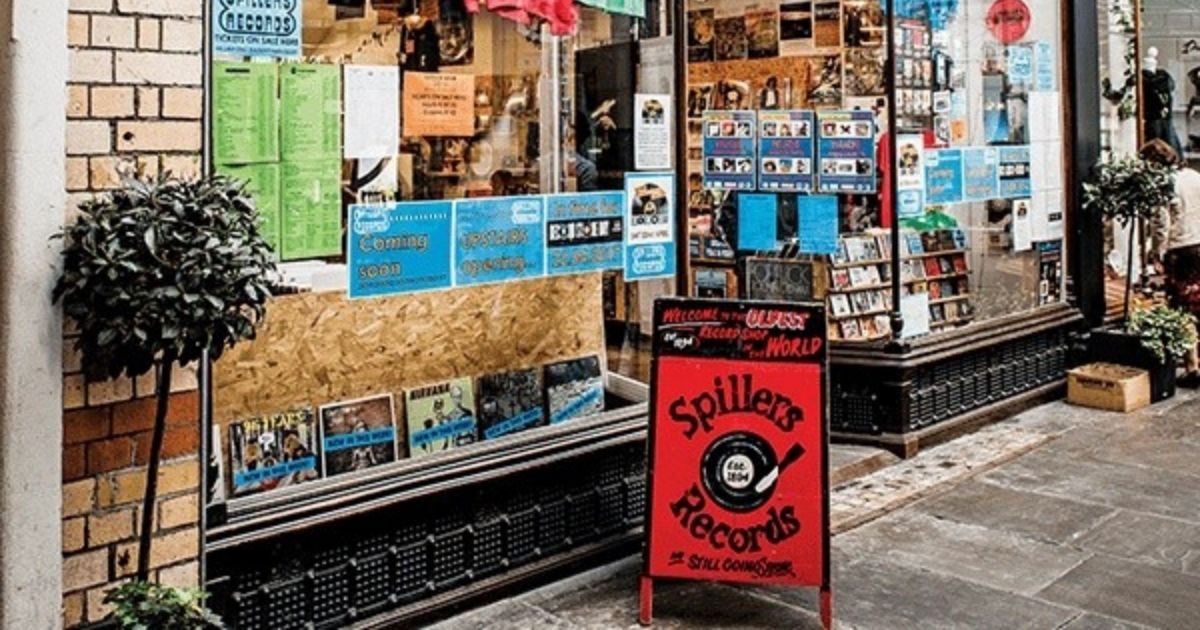
Those chats about politics, local issues, work, books, films and so on are not the primary function of, for example, my favourite record shop – Spillers Records in Cardiff’s Morgan Arcade. But it’s damned hard for Spillers’ primary function – the sale of music for profit – not to happen without the sociality. Try it.
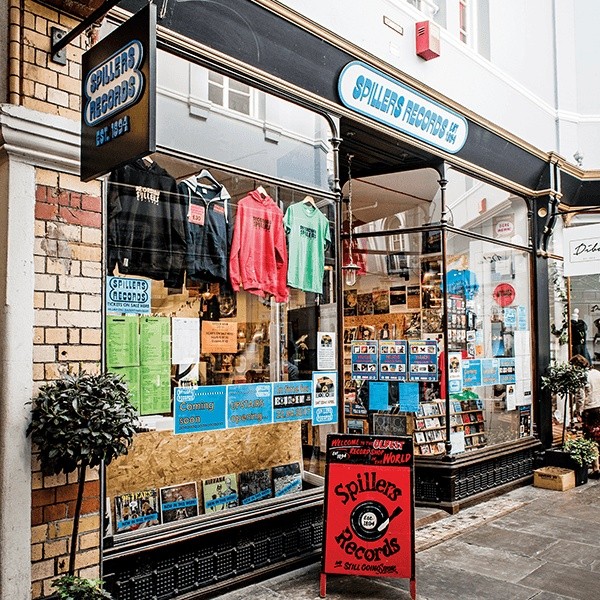
Cards on the table time #2: not only is Spillers a Cardiff institution (don’t take my word for it, take James and Nicky’s from the Manic Street Preachers), the world’s oldest record store no less; but it’s a family institution. My cousin Ashli runs it now having taken it over from her dad, my uncle Nick (himself a Cardiff institution), who is my dad’s first cousin and who have always been very close. Moreover, for years my father supplied Nick with those iconic red carrier bags resplendent with the black Spillers Records logo.
“Iconic”? Again, don’t take my word for it, take Nicky Wire’s:
If you walked around Cardiff with your Spillers carrier bag, it was like a badge of honour*. You were one of the indie elite
[*though when I was younger I never really saw them as such a badge. They were merely those bags that were kept in the piles upon piles of boxes in my parents’ out-house which got in the way of me getting to my Raleigh Lizard]
Klinenberg’s recent work builds on the work primarily of two preceding American sociologists: Robert Putnam and Ray Oldenberg. Putnam (2000) talked about the vitality and health of, and public trust in, “civic infrastructure” being nurtured and sustained by informal social networks. While Oldenberg’s (1989) work on“inclusively sociable” ‘third places’ demonstrated the value of spaces like diners, salons, cafes and stores for building trust (that word again) and community.
If one were to survey Spillers customers I suspect words like ‘trustworthy’, ‘values’, and ‘community’ would figure prominently in the vocabulary of their replies. And in the replies of customers of Vod Music in Mold, of Newport’s Kriminal Records and Diverse Vinyl, of Moonlight in Wrecsam, of Probe in Liverpool, of Cob in Bangor, of Andy’s in Aberystwyth, Derricks in Swansea, of Kelly’s in Cardiff Market, of Vinyl Frontier in Barry and so on……
Elsewhere, Dan Gregory (2018) refers to “our civic operating system” which might helpfully keep social infrastructure relevant in the modern digital age. Though I’d argue that it shouldn’t need to be made relevant.
Perhaps the terminology is part of the problem. The term ‘infrastructure’ is not a sexy term. By definition, infrastructure tends to refer to those essential, critical amenities that are there, but not necessarily obviously so. We don’t tend to think about the sewerage infrastructure, but good lord we notice when it malfunctions. Likewise, flood defences or care homes, to draw on the flooding and Covid-19 traumas that have accompanied the first quarter of 2020.
Gregory suggests that social infrastructure could be re-branded for the C21st as BaseLayer, Groundr or UnderWare. He’s not being entirely facetious either.
Infrastructure connotes that ‘stuff’ that requires long-term planning, large expensive investment, and niche specialist knowledge, expertise and skills to manage it; its benefits are seldom realised in the short-term.
But not only is our economy largely intolerant of and impatient for long-term returns, it fetishizes the shiny, innovative, techtosterone-fuelled (™ Mark Hooper) start-up cultutre. And obviously we’ve all had enough of experts…
Perhaps that’s why our civic infrastructure feels creaky; our civic operating system feels glitchy. And that was before Covid-19 placed unprecedented – and growing – strain on health/social care services and supply chains.
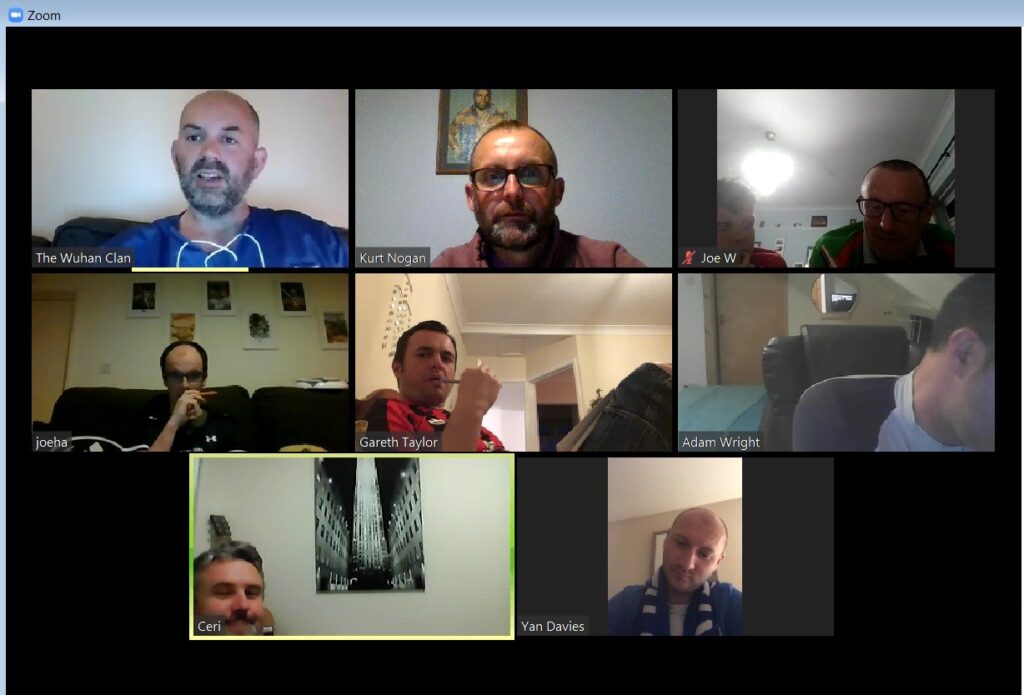
There is a final critical element of theory social infrastructure I’d like to raise at this point; and it is one that also draws on the recent novelty of migrating our social interactions – our lunches, our catch-ups, our check-ins, our pub quizzes, our listening parties – to Zoom and Houseparty.
Spaces like Spillers, Klinenberg argues, serve not only to promote sociality by amplifying connections within groups, but:
they can also orientate people towards interacting across difference
i.e., facilitate the production of bridging social capital. As James says in that Manics/Spillers clip:
When we were busking [at Spillers] and playing records we’d be looking round for a sign, a signal that people might be interested in us…
This shop would give you the clue that they might be because there were people buying records which you thought you were the only person in the world that owned.
It was a ray of light.
In a very recent Tortoise interview Robert Putnam calls for an emphasis on building bridging social capital post-Covid-19. He’s actually been arguing for this for many years; for Putnam the pandemic is merely reinforcing his view. For this to happen we need spaces – the infrastructure – where connections and interactions can happen; where the signs and the signals (sometimes subtle) can be displayed. Does Zoom allow for these? Arguably not and furthermore how many of us are Zooming people we don’t know, who are different to us and have different tastes and views? My guess is very few.
This is fine and perfectly understandable in the early days of enforced lockdown, self-isolation and social distancing (though should we be calling it physical distancing instead?). Zoom is providing us with means of remaining sociable with those in our networks beyond our immediate household and of reducing the fear and uncertainty about the health of ourselves and our loved ones, our employment and income, and our children’s education.
The longer it goes on, however, will Zoom calls with our immediate connections continue to to shrink our encounters with difference, thus eroding bridging social capital? What on Zoom provides those ‘rays of light’ that were so culturally important to and influential on the nascent Manics in Spillers? It’s admittedly difficult to do while we must continue to socially/physically-distance from others, but Putnam (2020) stresses we need:
to reinforce…living near and putting yourself in the shoes of people who are not like you
This will require us to emphasise, value and make use of our local social infrastructure to refill our reservoirs of social capital, especially its bridging form. But our Social BaseLayer will need, obviously, to still be around post-lockdown, which will be difficult for lots of the commercial forms of social infrastructure given the difficult trading conditions at present.
Our Random Act of Social Capital #26 has encouraged people to support independent record shops during lockdown. So why not buy something mail order from one close to you on what would have been Record Store Day, thus giving them a fighting chance of still being around for us to wander into and browse after lockdown.
And if you’re interested, I’ve ordered the new Derrero LP Time Lapse.