
Andy Green provides an update on an exciting project he’s working on celebrating his East End of London Cockney roots and The Modern Cockney Festival.
In September 2022 David Beckham received widespread accolades for joining the thousands of people to queue for 12 hours to pay his respects to Queen Elizabeth II’s Lying in State. Beckham’s decision to queue was inspired by the memory of his East End grandparents. “It was what they would have done”, Beckham said. What they would have wanted him to do, showing values at their finest.
A positive sense of identity is the foundation for self-esteem, well-being, and purpose. It’s a potent resource to contemporary
challenges, for facing and overcoming adversity, building a greater sense of togetherness in an increasingly divided world, and being more purposeful, as well as fostering resilience.
In the same way some feel passionate about their Irish, Jewish or other identities, a sense of being a Cockney, whether you are first, second, third generation or beyond, inspires realising your greater potential, guiding you for doing the right thing, making the most of you, and your situation. But only if you recognize it and tap into its rich assets.
All social identities evolve. Yet for Cockneys, their sense of identity of who is, and what does it mean to be a Cockney, is an evolving story defined and largely told by others.
At best it’s seen as a fossilized caricature, at its extreme, a stereotype for racists, or even being airbrushed out of history, as if it has never existed.
And it’s not just Cockneys who face challenges about their identity. There’s now evidence of declining use of regional identities
across the UK. Unless these identities are given real, positive, and relevant meaning, their decline will continue, diminishing their potential to enrich individuals and communities. For the moment however, my collaborator Saif Osmani from the Bengali East End Heritage Society and I are focusing on Cockney.
Not many people know that…
The first mention of Cockney was in 1362 by Piers Plowman who referred to ‘a small mis-shapen egg’. Twenty years later, in The Reeve’s Tale in the Canterbury Tales (1386) ‘cockenay’ was a derogatory term for London town dwellers.
In Brick Lane, stands a former Huguenot, Methodist Church, Synagogue, and now Mosque.
People, culture, and language evolve too. In 2012, Muhammad Shahid Nazir from his fish stall at Green Street Market shot to national fame with an appearance on TV’s ‘The X Factor’ as the ‘£1 a fish man’ – creating a contemporary fusion of Pakistan meets the traditional Cockney market trader.
London’s history is one of a constant influx of new arrivals, from all parts of Britain, Ireland and beyond. Significant waves of new arrivals included the Huguenot refugees, Askenazim, Jews of Polish and German origin, the Irish diaspora, later waves of Jewish immigration from Russia and Poland, the Chinese community, from all parts of the Commonwealth post-1945, through to ‘New Whites’ of Eastern Europeans.
Every new incomer creates new iterations of Cockney, contributing to an ever-evolving cocktail of local culture.
All social identities defined by both geography and social class face this challenge. There aren’t Royal Institutes of Cockney, Brum, Geordie, Scouse or Weegie. Compare Cockney with Welsh. Wales has a population of just over 3 million, similar – if not smaller – to the number who can claim a Cockney identity. Yet, in Wales there are hundreds of organisations promoting Wales and Welsh culture, compared to a handful, if that, that promote a Cockney identity and heritage. As a result, the Cockney story, is one defined by, and told by others, not by Cockneys themselves.
What is The Modern Cockney Festival?
Between March 3rd and April 4th 2023 The Modern Cockney Festival will celebrate the evolving story of Cockney and explore how it can be even more relevant for those who identify with ‘the common Londoner’ in the 21st Century. It will provide, for the first time, a space enabling people to give themselves permission to explore, engage, and celebrate their story of Cockney.
Cockneys, unlike many other local social identities, have never been identified by a connection with the soil or land but rather by the shared social space with people like themselves.
The Festival will act as a focal point for conversations about the evolving Cockney identity and narrative. It provides a platform for exploring its identity, inspiring a greater sense of connectedness and pride, a starting point for campaigning against social class bias, the need for further research, addressing the questions: What does it mean to be Cockney in the 21st Century; and why is this important?
Here is a flavour of the things we are planning:
Exhibitions and displays
- The evolving story of ‘Cockney in 50 objects’ bringing alive what defines being Cockney
- The ‘Pearly Burka’ – an iconic symbol of Cockney’s evolving character and fashion spanning different cultural groups and generations. We’ll be using this image to inspire conversations with a longer-term goal of using its inspiration for a public artwork
Events
- Speak Cockney Day on March 3rd – the ‘fird of the ‘fird – providing a focal point for starting our celebrations of all things Cockney
- A Cockney debate: East End only, or a global Cockney Diaspora?
- Learn rhyming slang old and new – sessions for children and adults
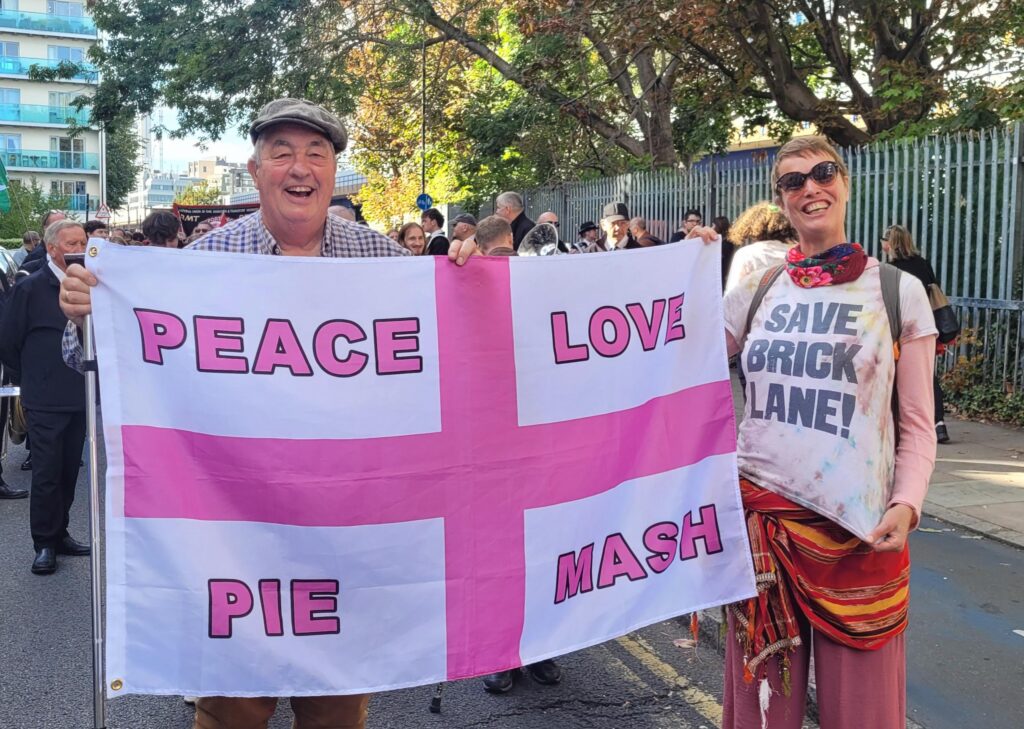
- Pie’n’mash shop events
Cockney Chat badges
- Show your pride in and become an ambassador for promoting your Cockney identity with our ‘Cockney Chat’ badges.
- We are looking for a charity partner that aligns with our values and mission to raise funds for their cause and spread the Cockney Chat message
So watch this space and if there’s any members, like me, of the Cockney Diaspora are interested in getting involved email us at [email protected].
Lastly, here’s how W.H. Davies in his ‘The Autobiography of a Super-tramp‘ described Cockneys in 1908:
“Cockneys make good beggars. They are held in high esteem by the fraternity in America. Their resource, originality and invention, and a never faltering tongue, enables them to often attain their ends where others fail, and they succeed where the natives starve.”