
It is almost three years since Andy and I wrote the first article in Planet – The Welsh Internationalist’s Possibilities for a Post-Pandemic Society series.
The series invited contributors to project years ahead and conjure up potential futures that the pandemic could lead to. Unashamedly Utopian, it wanted to explore what ‘new normals’ (remember them?) might look like; and what would need to happen to bring them about, rather that slip back into old habits.
In 1982, darling of the right Milton Friedman wrote:
“Only crisis – actual or perceived – produces real change. When that crisis occurs, the actions that are taken depend on the ideas that are lying around”
I am not usually inclined to quote Friedman but it came to mind as we were considering what form our article should take. One of the ideas that was ‘lying around’ was the value of social infrastructure, ironically at a time when we were confined to our homes in order to stop the spread of the virus. The ‘critical mundanity’ of such infrastructure really hit home when we were prevented from using it.

We had also come off the back of reading Eric Klinenberg’s sociological study of Chicago’s fatal 1995 heatwave, Heat Wave: A Social Autopsy of Disaster in Chicago. It got us thinking: How might that crisis inform us in Wales and the UK as we were coming to terms with the potential implications of the covid-19 pandemic?
The article can be read here (£) and in it we argued that one Possibility might be investment in social infrastructure that encourages, facilitates and nurtures different types of voluntary associations by people. It is timely that I was thinking of the article again because recently William Hague wrote in The Times about the need to re-invigorate social participation by heralding a ‘volunteering revolution’.
Leaving to one side the fact that Hague probably got paid for the article rather than did it voluntarily, it feels a bit Big Society Mk.II: the state retreating from its long-time social and economic obligations, abandoning some communities to fend for themselves, thus deepening inequalities.
Hague seems oblivious to the fact – as we argued in our Planet article, and which was backed by Klinenberg’s post-heatwave inquiry in Chicago – that:
Social interaction [is] a natural, everyday occurrence, even in times of distress and crisis; it [does] not need to be manufactured or mandated from outside or above
The critical thing in this ‘naturalness’ is that people freely interact and have the spaces to do so, be they physical spaces (e.g., community centres, cafes, coffee shops, salons, parks), or cultural spaces (e.g., choirs, reading groups, parent/toddler groups). Hague can induce, tempt, prompt and prod all he likes, but manufactured associations will soon fizzle out because people are likely to be less invested in them if they are not started organically and with sufficient ‘localness’ to make them appeal to people, who’s prime motivations for participation tend to be an interest in some sense of community, be it of geography, of shared characteristics, of interest (or the intersectionality of these).
Someone who had read our Planet article got in touch to say, in essence, ‘this is all well and good but a decade of austerity has gutted public budgets, so what is going to pay for all this?’. Four things come to mind by way of response.
Desmond, Sharon and Shirley
Firstly, social infrastructure can be just as effective in its ‘connectability’ of people in private hands as it is in public ownership and management. Remember the 1990s British sitcom ‘Desmonds’? It was set in a barber’s shop in Peckham, London run by the titular barber, Desmond Ambrose. Its recurring characters would spend much of each episode engaged in debate, counsel, mickey-taking, and philosophising. It showed the importance of barbers (and salons) to communities with large populations of people with African and Caribbean heritage. Sharon Betts’ salon in Cleethorpes, Umojah, is a real-life example and which is very much seen as a social hub. This recent Nation Cymru article about Shirley’s barbershop in the Cefn Fforest in the Gwent valleys is another example, as well as showing the importance of miners’ institutes for furthering social connections.
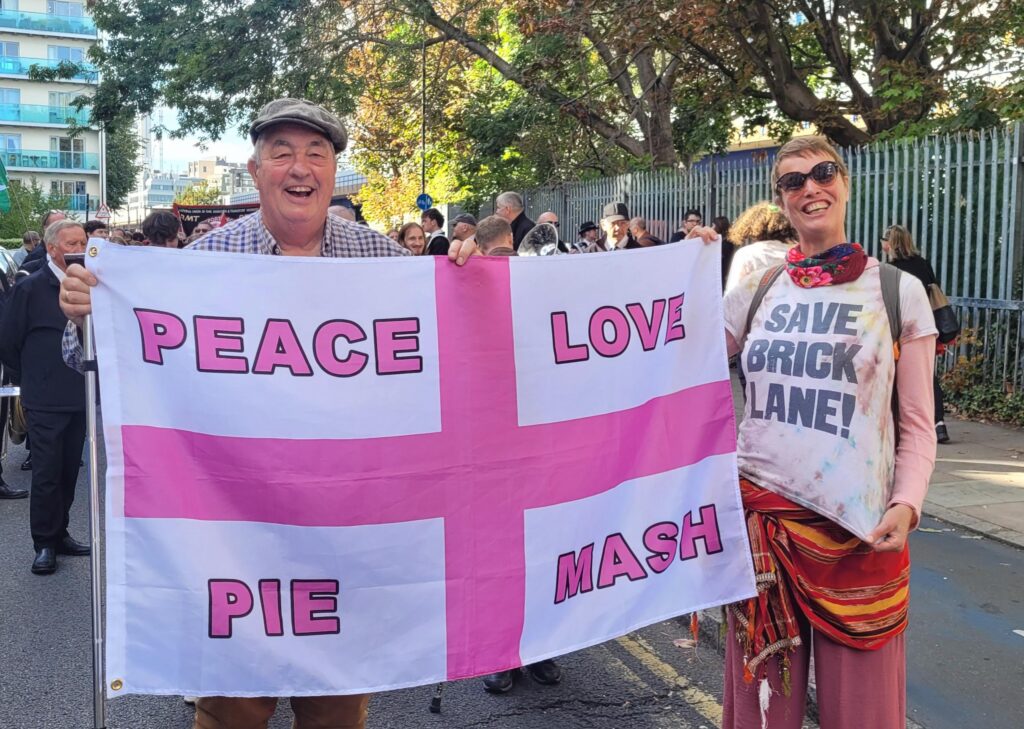
Pubs are social infrastructure, as are the pie ‘n’ mash shops with which our Andy Green was tempting our taste buds during one of the recent Modern Cockney Festival talks on Cockney cuisine. The more we think about where we have encounters and interactions with others – no matter how tacit, brief, or mundane – they are often in places that are not in public ownership (which is not to say that public bodies such as local authorities don’t have any role to play in these in respect of the vitality of these infrastructure, e.g., sympathetic planning decisions, rates collection, waste services, etc.).
Community ownership of social infrastucture
This leads me onto the second response. The public/private binary limits our imagination to other forms of ownership, both in a literal, legal sense (e.g., community owned pubs in communities, both rural and urban, where the private, marketized model has failed, e.g., Llanfrothen), and in the more abstract. Social infrastructure is ‘social’ because of the connections and interactions it fosters; the more meaningful these are the greater sense of belonging people will have to it. Consider your favourite café, pub or library – do you have a preferred seat? From this preferred seat do you time and again see the same faces? More than likely you do, and even if you do not know their name, the tacit, non-verbal indications we pass between one another are more important than perhaps we realize (see also the ‘Cheers, drive’ as you alight the bus). They also serve to fill our ‘human reservoirs’ drop by drop. In Chicago, Klinenberg observed how people cited fleeting and tacit interactions being as important to their coping with the 1995 heatwave as the more embedded connections of home and hearth.
This suggests a less tangible sense of ‘ownership’ can be developed through being somewhere you can be yourself; where you are accepted, not judged; somewhere you can express yourself and your identity. It might simply be somewhere where someone says ‘hello’ to you and takes an interest in you. The most effective social infrastructure will be those spaces where people’s interactions go beyond the merely transactional, i.e, buying a drink, using a service, receiving advice on housing benefits, using the PC. Spaces where people can generate reciprocities and serendipities, and where they can both give and receive things of benefit to themselves and others will deepen people’s attachment to social infrastructure. Where appropriate, more abstract and emotional forms of ownership should seek to be converted into more literal and legal forms of ownership and management. By this I mean public bodies who own facilities and amenities should always have as an option – when the time is considered mutually ideal – to hand social infrastructure over to communities for them to run.
Get out of the way!
Thirdly, there is no question ideologically-dogmatic austerity has had a profound economic and financial impact on many communities. However, thinking of social infrastructure has something which only costs money is extremely short-sighted. As Professor Ted Cantle, an expert on community cohesion and inter-culturalism, said on a recent episode of our friend Dr Rob Watson’s Decentered Media podcast:
“It’s a real disappointment that levelling up hasn’t embraced the need to try and level up on social capital itself. I know that’s the rhetoric, but when you look at the monies that have been allocated, there’s really no focus on social capital”
For Cantle, a ‘cohesive community’ i.e., one in which there is a deep reservoir of social capital, has a mix of different forms of capital: economic, cultural and social. If one form is dwindling then the others should be put to use to offset, halt and hopefully reverse that decline. Nevertheless, Hague and other policymakers, would also do well to consider what Francis Fukuyama wrote in 2010:
“While awareness of social capital is often critical for understanding development [economic, civic etc.], it is difficult to generate through public policy”
“Difficult”. But not impossible. Not if those policies concern themselves with creating the conditions that put people in charge to develop those things that matter to them. Hague is right to identify volunteering as an example of strong social capital, but he’s wrong in assuming that the latter comes about through mandating the former. Policy needs to provide the financial means for people to create and nurture their social capital, but also needs to ‘keep its nose out’ and give things time. Maybe policy and professionals can come in and construct some ‘social scaffolding’ from time to time to help and provide additional capacity or specific expertise (e.g., legal, fundraising, inclusion and equality, risk assessment) but this is quickly dismantled when it has serves its purpose, rather than get left in place.
Social infrastructure as civic associations
Lastly, social infrastructure is spaces – cafe’s, pubs, libraries, etc. – but they are also the civic associations, groups and networks that we establish. Yes, these may occur or are tangibly expressed in somewhere comprising bricks and mortar, but they could just as easily exist online – as indeed the pandemic forced many to do so – or in any space. Those community organizations that do get set up – choirs, sports clubs, Friends groups, parent-teacher associations, campaigning groups and so on – invariably do so because people want to set them up not because in some top-down manner they are pushed to do so. The voluntary nature of such associations is wherein lies their strength and what Hague deems to be declining.
Then again, It should come as little surprise that a right-of-centre critique on participation should focus on people’s pathologies and that the current generation is perceived to be shunning that which generations before did with a sense of duty. The past is all too often to the likes of Hague hagiographically mis-remembered as some Golden Age.
As Robert Putnam observed in Bowling Alone (2000), participation has been declining for many years; it is not a recent phenomenon.